
AI FOUND IT. DO YOU UNDERSTAND IT?
The Tools Are Getting Smarter. Are We?
Three Takeaways from ASNOA Connect 2026
There was no shortage of conversation about artificial intelligence at ASNOA Connect 2026.
How agencies are using it. How much time it can save. How it can assist with marketing, meeting notes, policy comparisons, renewals and everyday agency operations.
None of that was particularly surprising.
What was more interesting was what happened when we began connecting ideas from different sessions.
Because another message emerged.
The more capable our tools become, the more important the knowledge of the person using them becomes.
AI is already moving faster than many agencies
During the Liberty Mutual keynote, we saw data showing that individual adoption of AI is moving considerably faster than formal agency implementation and governance.
We also saw examples of where AI is already being applied: summarizing meetings, generating marketing content, comparing policy details and automating routine tasks.
The technology discussion has clearly moved beyond:
"Will insurance professionals use AI?"
They already are.
The better question is becoming:
Do they know enough to evaluate what AI gives them?
An AI system can summarize an endorsement. It can identify a difference between expiring and renewal policies. It may even flag something as a potential coverage gap.
But identifying a difference and understanding its significance are two very different things.
That distinction matters.
AI isn't just changing how insurance professionals work. It's changing the risk we're insuring.
That became particularly apparent in another session addressing real-world claim scenarios.
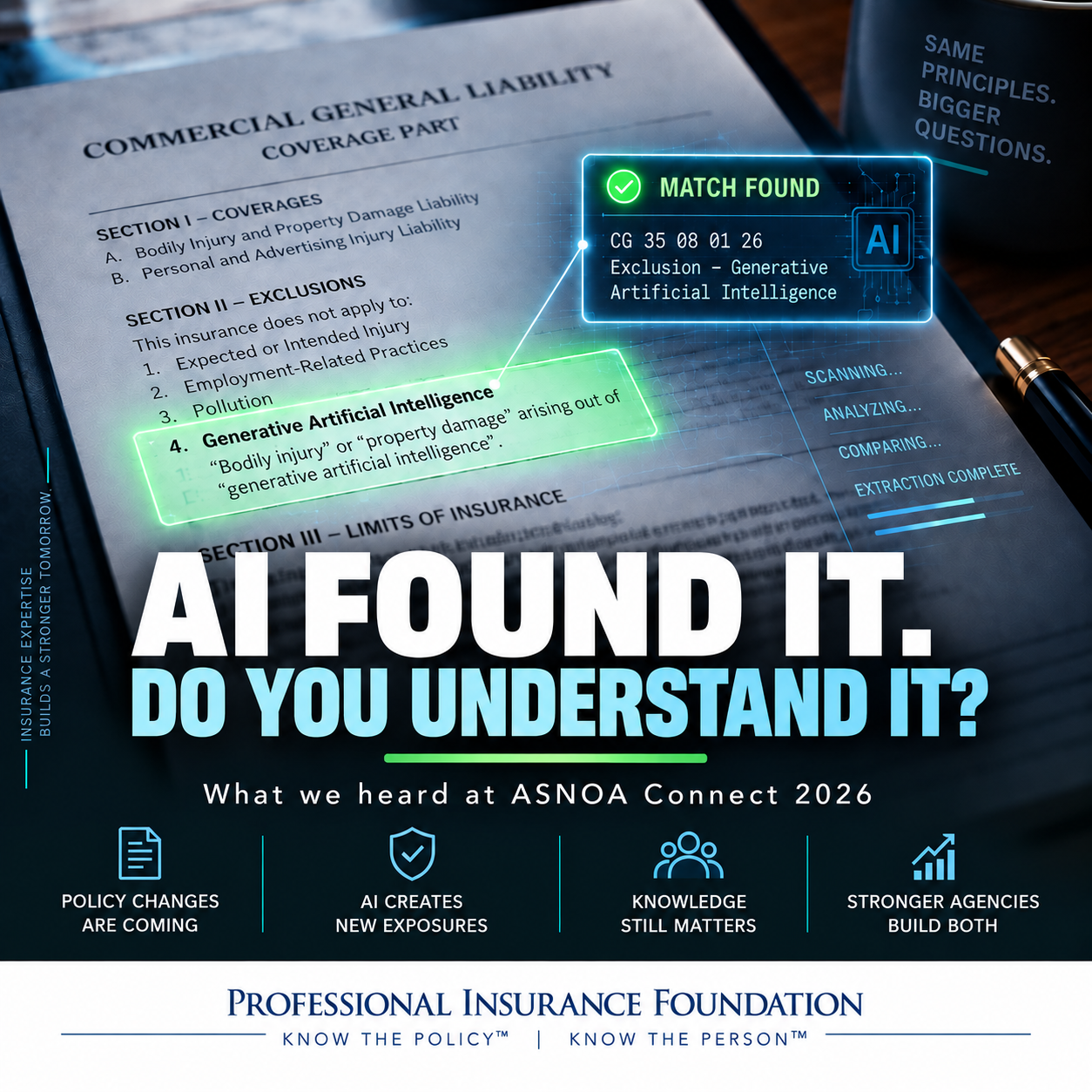
We saw emerging policy language specifically addressing artificial intelligence, including ISO's new generative AI exclusions and examples of proprietary carrier language addressing AI-related exposures.
We also saw how widely some of these forms are beginning to move through the regulatory filing process.
Think about what that means.
AI has become a coverage issue.
And that potentially changes the exposure analysis.
Does the insured use AI?
Where?
Is it customer-facing?
Does it generate content?
Does it make recommendations?
Is AI incorporated into a product or service?
Can a chatbot make representations to a customer?
Those aren't questions about technology for technology's sake.
They're insurance questions.
And as exposures evolve, policy language will continue evolving with them.
AI can find the endorsement. Someone still has to understand it.
This may have been our biggest takeaway from the conference.
One session demonstrated increasingly sophisticated tools capable of assisting with policy checking, renewal comparisons and identifying discrepancies.
Then, in another session, insurance professionals were given some wonderfully straightforward advice:
Build proficiency in the products you sell.
And:
The insured should read the policy. But so should you.
Put those two ideas together.
Imagine that technology identifies a newly attached endorsement at renewal.
Excellent.
Now what?
Someone still needs to understand what coverage existed before the endorsement was added, what the endorsement changes, how its wording interacts with the rest of the policy, whether the insured has an exposure affected by it, and whether that warrants a conversation with the client.
Finding policy language is information retrieval.
Understanding what that language means to an insured is insurance expertise.
Those are not the same skill.
The "human advantage" requires knowledge
Another keynote slide identified several capabilities humans continue to perform particularly well: empathy, relationship building, critical thinking, ethical judgment and navigating ambiguity.
Those capabilities matter enormously in insurance.
But there's another layer worth considering.
You cannot critically evaluate a coverage recommendation if you don't understand the coverage.
You cannot effectively navigate ambiguity in policy language if you don't understand the contract.
And professional judgment becomes considerably harder when the person exercising that judgment doesn't possess the technical foundation necessary to recognize that something may be wrong.
AI fluency and insurance proficiency aren't competing skills.
We're going to need both.
That creates a different question for agency leadership
For years, agencies have invested heavily in training their people.
That's important.
But as technology becomes increasingly capable of putting an answer in front of an employee almost instantly, another question becomes increasingly important:
Do we know what our people actually know?
Training tells us what someone has been taught.
Experience tells us how long someone has been doing the job.
Neither necessarily tells us what that person understands today.
Assessment can help establish that baseline.
And once strengths and knowledge gaps become visible, professional development can become much more intentional.
That's the relationship we see between Know The Person™ and Know The Policy™.
First understand where proficiency exists.
Then build where it doesn't.
The takeaway from ASNOA Connect
We left ASNOA Connect optimistic about what AI can do for independent agencies.
These tools can eliminate repetitive work, accelerate research, surface information and give insurance professionals more time to do the things that require human judgment and relationships.
But that doesn't diminish the importance of technical insurance knowledge.
It may do exactly the opposite.
Because when technology can produce an answer in seconds, the differentiating skill may no longer be the ability to find the answer.
It may be the ability to recognize whether the answer makes sense.
AI can help you read the policy. It can't replace knowing the policy.
The future of the independent agency may be increasingly powered by artificial intelligence.
But understanding the risk, interpreting the policy and advising the client still requires people who know what they're doing.
