Our Courses

Professional Insurance Foundation delivers highly-rated, quality insurance training through our Know the Policy platform. Select a course to learn more about our training.

Know the Policy virtual training on instructor laptop with coffee mug next to computer

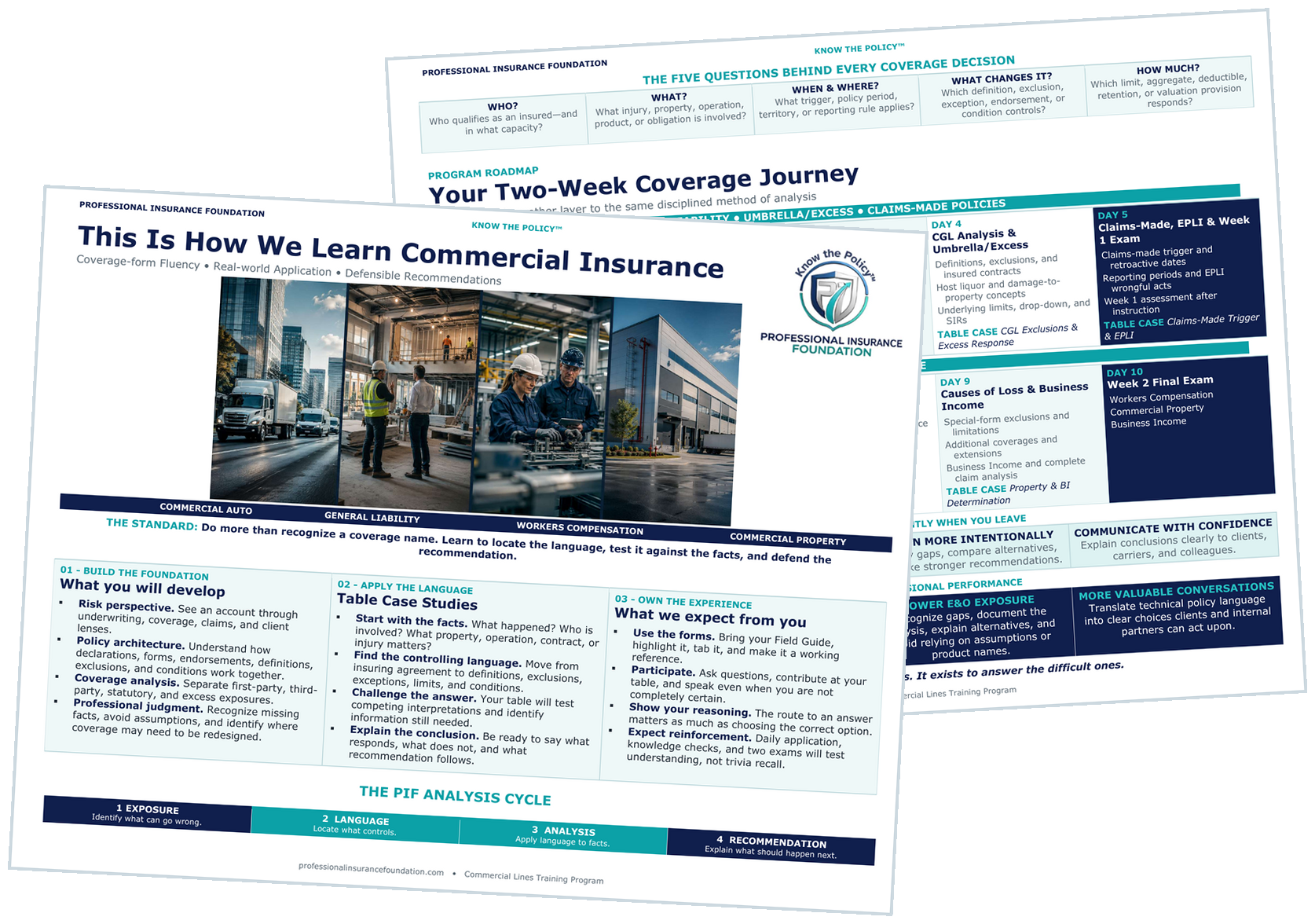
Our Two-Week Course

Know the Policy’s immersive two-week program is delivered virtually via Adobe Connect and is designed to build deep, practical confidence in policy interpretation and application. Classes meet Monday through Friday from 11:00 a.m. to 1:00 p.m. ET, then reconvene from 2:30 p.m. to 4:30 p.m. ET, spanning two weeks.

Participants complete homework between sessions, along with assessments throughout the program, to reinforce learning and ensure comprehension of key concepts.

The course strengthens an insurance professional’s ability to read, interpret, compare, and apply ISO and NCCI policy forms with clarity and consistency. While real-world claims scenarios are used to illustrate how coverage applies, the primary focus remains on policy language, structure, intent, and risk transfer mechanics.

By the end of the program, participants are better equipped to make defensible coverage recommendations and explain those recommendations clearly and confidently to insureds.

Week One

Policy Structure & Core Commercial Lines

  • Topics May Include:

    How ISO and NCCI develop standardized forms

    The anatomy of an insurance policy:

    • Declarations

    • Insuring agreements

    • Definitions

    • Exclusions

    • Conditions

    • Endorsements

    • How courts interpret policy language

    • Why small wording differences matter

    Applied Learning:

    • Guided walkthrough of a full ISO policy form

    • Identifying “grant, limit, take-back” language patterns

  • Topics May Include:

    • ISO Business Auto Coverage Form structure

    • Covered Auto Symbols — intent vs common misuse

    • Liability, Physical Damage, Medical Payments, UM/UIM

    • Who Is an Insured analysis

    • Limits, deductibles, and coverage triggers

    Application Examples:

    • Symbol mismatches

    • Employee vs non-employee drivers

    • Owned vs hired vs non-owned autos

  • Topics May Include:

    • Purpose of auto classification systems

    • ISO commercial auto classifications

    • Vehicle types, radius, use, and exposure indicators

    • Common classification errors and their consequences

    • How underwriting and claims outcomes are impacted

    Workshop:

    • Classifying real-world commercial auto risks

    • Identifying misclassified exposures

    (Remaining instructional time continues Auto policy analysis)

  • Topics May Include:

    • ISO CGL Coverage A, B, and C explained through form language

    • Occurrence definition and coverage trigger analysis

    • Products vs premises vs completed operations

    • Additional insured endorsements and contractual risk transfer

    • Limits, aggregates, and erosion concepts

    Application Examples:

    • Construction and service contractor exposures

    • Vendor and landlord requirements

  • Topics May Include:

    • ISO Commercial Property Coverage Forms

    • Causes of Loss forms (Basic, Broad, Special)

    • Valuation clauses and their implications

    • Business Income, Extra Expense, and Period of Restoration

    • Common misconceptions and coverage gaps

    Policy Workshop:

    • Mapping loss scenarios to coverage grants

    • Identifying time-element limitations

Week Two

Advanced Policy Analysis & Modern Tools

  • Topics May Include:

    • NCCI structure and purpose

    • Workers Compensation policy anatomy

    • Part One vs Part Two explained

    • Statutory benefits vs employer liability exposure

    • Other states insurance and endorsements

    Application Focus:

    • Multistate operations

    • Common coverage misunderstandings

  • Topics May Include:

    • Claims-made vs occurrence in policy language

    • Retroactive dates and prior acts

    • Extended Reporting Periods (tail coverage)

    • EPLI, Professional Liability, Cyber — form mechanics

    • Common agent pitfalls

    Workshop:

    • Comparing claims-made endorsements side by side

  • Topics May Include:

    • Why endorsements exist

    • How endorsements modify coverage grants

    • Reading endorsements in proper sequence

    • Manuscript endorsements vs ISO forms

    • When endorsements unintentionally reduce coverage

    Applied Learning:

    • Endorsement stacking exercise

    • Identifying hidden coverage erosion

  • Topics May Include:

    • Using Generative AI as a policy comparison assistant, not a replacement

    • Prompting techniques for:

      • Comparing ISO forms

      • Identifying differences between editions

      • Highlighting coverage gaps

    • Validating AI output against actual policy language

    • Ethical and compliance considerations

    Hands-On Workshop:

    • Side-by-side policy form comparison using AI

    • Turning AI output into agent-level explanations

  • Morning Session – Integrated Policy Analysis

    • Comprehensive case study requiring:

      • Policy selection

      • Coverage justification

      • Identification of exclusions and endorsements

    • Group discussion on defensible recommendations

    Afternoon Session – Sales & Advisory Application

    Non-CE Sales Workshop:

    • Translating policy language into client-friendly explanations

    • Positioning coverage depth as a value differentiator

    • Using policy comparisons in renewal conversations

    • Avoiding over-promising while still advising confidently

    Role-play: explaining why one policy is better than another

Coming Soon:

Introduction to Auto Claims for the Non-Claims Professional

This “work in progress” course will provide insurance professionals with a practical, high-level understanding of the auto claims process from first notice of loss through resolution. Designed specifically for agents and professionals in non-claims roles, the course focuses on how auto claims are evaluated, why carriers make certain decisions, and how to better guide insureds through what is often a stressful and confusing experience.

Participants will gain insight into what happens immediately after a loss, including best practices for insureds, drivable versus non-drivable scenarios, towing considerations, rental and loss of use issues, and common early-stage challenges such as delayed contact or report-only claims. The course also explores how modern auto claims are handled, including carrier repair networks, appraisal methods, and damage evaluation.

A core component of the course examines coverage and liability fundamentals, helping participants understand how policies respond and how outcomes can be affected by limits, deductibles, exclusions, and use-based scenarios. Attendees will also learn how liability is assessed using real-world investigative factors, along with how carriers evaluate damages, distinguish between repairable and total losses, and assess bodily injury exposure.

The course concludes with key claim resolution concepts, including subrogation, deductible recovery, and out-of-pocket expense reimbursement. These topics are designed to help professionals set realistic expectations and communicate more effectively with insureds throughout the life of a claim.

What You’ll Learn

  • The auto claims process from first notice of loss to resolution

  • What insureds should expect immediately following a loss

  • How carriers evaluate damage, liability, and coverage

  • Key drivers of claim value, settlement risk, and outcomes

  • How to better support and guide insureds through the claims experience

Outcome

By the end of the course, participants will have a clearer, more confident understanding of auto claims operations. This knowledge allows professionals to better support clients, anticipate common issues, and bridge the gap between underwriting, sales, service, and claims.

Contact Us

Looking for training that fits your team? Contact us to select a ready-made course or create a custom one, designed for your team. We offer virtual programs designed to support onboarding, development, and long-term success.

Have questions or want to explore options? We’d love to hear from you.